Showing posts with label Euro. Show all posts

Thursday, June 11, 2009

Pound hits 2009 high against euro

Pound v Euro
Sterling has reached its highest level against the euro since the start of the year after data suggested the UK recession may be over.

One pound was worth 1.1758 euros in early afternoon trading, having closed the previous day at 1.1672 euros.

On Wednesday the National Institute of Economic and Social Research estimated that the economy grew in April and May.

The pound was also boosted by data showing industrial output rose in April - the first monthly rise in 14 months.

In addition, the pound's rise was aided by a survey on attitudes to inflation by the Bank of England, which showed inflation expectations for the coming year rose to 2.4% in May from 2.1% in February, the first rise since August.

Sterling was also up against the dollar, rising one cent to $1.6429.

The pound had fallen against both the euro and the dollar last week and at the beginning of this week amid concerns about possible challenges to the leadership of Gordon Brown.

However, in the past couple of days the political situation appears to have stabilised.

Sunday, February 15, 2009

Europe hit by economic slowdown


European economies contracted in the fourth quarter of last year, with some countries registering the worst figures in decades, official data shows.

The eurozone economy shrank by 1.5% in the previous quarter and 1.2% on the year, Eurostat said.

Germany's economy shrank by 2.1% compared with the previous quarter, its worst quarterly performance since 1990.

France shrank by 1.2%, initial data shows, while Italy registered a drop of 1.8%, the steepest drop since 1980.

The data puts pressure on the European Central Bank to cut interest rates.

In the whole of 2008, the economy in the 15 countries using the euro grew by 0.7% against the previous year, Eurostat said. Slovakia joined the eurozone on 1 January 2009, making it a 16-country club.

The Dutch economy shrank 0.9% during the quarter while the Austrian economy eased by 0.2%, the first drop in nearly eight years. In the same quarter, Portugal's economy contracted by 2% on the previous quarter and 2.1% on the previous year.

"These are huge contractions in Europe, the largest in living memory in most cases," said Ken Wattret, economist at BNP Paribas.

Companies have cut investment and exports have dropped as the global recession has taken hold.

European companies hit by the slowdown include Air-France KLM, which reported a third-quarter operating loss on Friday, and Michelin, whose final-year profits fell as the crisis in the global car industry took its toll on the tyre maker.

The decline in demand for cars was further highlighted by data released on Friday.

The number of new cars sold in Europe in January was down 27% compared with January 2008, the European carmakers' association, Acea, said.

Friday, January 2, 2009

Slovakia becomes eurozone member


Slovakia has become the 16th member of the eurozone - the second former communist country to join the grouping.

Up to 100,000 people gathered in the capital Bratislava's main square for a midnight ceremony with fireworks.

Slovak Prime Minister Robert Fico was one of the first to withdraw the new currency, taking 100 euros from a cash machine in the parliament building.

The Slovak koruna (crown) will remain in circulation alongside the euro until 16 January.

Cash machines were meant to be issuing euros from Thursday, while some banks planned to open, despite the New Year's Day holiday, to swap korunas for euros.

But the new currency was taking a while to filter through.

"None of my clients has paid with euros yet, everybody's using korunas," Marek, a 30-year-old taxi driver in Bratislava, told the AFP news agency.

At Bratislava's railway station, Richard Nedo, a 20-year-old waiter at an internet cafe, said: "Since we opened at 6am, we have had 10 customers but only three of them - foreign tourists - paid with euros. Slovaks are still using korunas."

Stability hopes

Slovakia sees its adoption of the euro as a shield from the turbulence that has hit currencies in neighbouring ex-Soviet bloc countries.

The koruna has been pegged at a rate of 30.126 to the euro since July, while Poland's zloty has lost 24% against the euro, the Czech koruna 11% and the Hungarian forint 13%, Bloomberg news reports.

A recent poll in Slovakia's Hospodarske Noviny daily showed 58% of respondents in favour of the euro, compared with 43% positive a year ago.

Euro "starter packs" have already been distributed in Slovakia and a big campaign has been under way to familiarise the nation of 5.4 million with the new currency.

Slovakia has enjoyed rapid economic growth since joining the European Union in 2004.

But the euro's strength may make life harder for Slovakia's exporters - particularly its big car industry - in the current economic downturn, correspondents say.

Slovakia's cabinet is counting on 4.6% economic growth, down from a peak of 10.4% in 2007, Reuters reports.

The small Alpine nation of Slovenia, formerly part of Yugoslavia, was the first ex-communist country to join the euro in its own right, two years ago.

However, the former East Germany - now part of Germany - has been involved in the euro project since the beginning.

Tuesday, December 30, 2008

Russian rouble slides to new low


The Russian rouble has hit a low after its central bank allowed the currency to devalue for the twelfth time - including nine falls this month.

It fell to 41.6 against the euro - an all time low - and to 29.3 against the dollar, the lowest level since 2005.

The currency has lost more than 20% of its value against the dollar - largely due to the slumping price of oil on which Russia's economy heavily relies.

The Kremlin has been using reserves to try and support the currency.

However concern that Russia is pumping too much cash into supporting the rouble prompted ratings agency Standard and Poor's to cut the country's credit rating earlier this month for the first time in nine years.

Borrowing plans

The rouble has also touched a new low of 34.8 roubles against the basket of euros and dollars which is its official measure within the country.

Russia's central bank, which sets the official exchange rates, does not normally allow the currency to lose more than 1% percent of its value in one day against the basket of currencies.

But it has gradually been devaluing the rouble by allowing deeper falls, with it sliding 1.5% on Monday.

Oil revenues have been the main driver of the boom enjoyed by the Russian economy in recent years.

But the sharp declines in the price of crude oil means Russia is facing economic challenges.

Its budget has been calculated on the basis if it getting at least $70 a barrel for its Urals crude - the country's main export blend. It is currently worth about $32 a barrel.

Last week the economic adviser to President Dmitry Medvedev said that the country would probably draw on further reserves and borrow from abroad to bridge the shortfall.

The central bank's first deputy chairman Alexei Ulyukayev said last week that it had opted to allow the rouble to devalue gradually instead of allowing a single, much larger devaluation.

The worsening economic outlook and the fall in the price of oil has left the government with little option.

Further falls

Russia's central bank has spent more than $100bn (£68bn) defending its currency since the summer.

Despite the fall in oil revenues, Russia possesses the world's third largest reserves of gold and foreign exchange reserves.

And the central bank is prepared to continue to defend the rouble in order to avoid a repeat of the 1998 financial crisis, when Russians rushed to withdraw their savings as the currency plummeted.

The Kremlin has warned that the global economic slowdown is continuing to take its toll - predicting that the number of people registered as unemployed would rise to about 2.2 million by the end of 2009, from the current level of 1.5 million.

Pound hits new low against euro


The pound has hit a new record low against the euro as the grim outlook for the UK economy continues to put downward pressure on the currency.

Weak house price data and figures showing that homeowners are choosing to repay their mortgages rather than spending, pushed the currency lower.

Low trading levels in the foreign exchange markets also helped to force sterling down to 1.0198 euros.

Many analysts believe parity with the euro is now only a matter of time.

The rate for tourists buying their currency before they travel has almost reached parity, where one pound buys one euro. At one major High Street currency exchange, 100 euros currently costs £99.11.

Downward pressure

Property consultants Hometrack predicted a 12% fall in UK property prices in 2009, while figures from the Bank of England showed that households were more keen to pay off their mortgages than borrow money against the value of their homes for spending.

Towards the end of October, one pound bought 1.287 euros. But a string of bad news about the prospects for the UK economy caused sterling to fall.

In December last year, a pound would have bought more than 1.4 euros. At its peak in 2000, the pound was worth more than 1.7 euros.

There are two main factors putting downward pressure on the pound, analysts suggest.

First, interest rates in the UK are lower than those in the eurozone, which makes the pound less attractive to foreign investors.

Analysts believe the economic slowdown in the UK will be more severe than in the eurozone, which means the Bank of England could be forced to lower interest rates from their current level of 2%.

Interest rates in the eurozone currently stand at 2.5% and the European Central Bank has hinted that further rate cuts are unlikely early in the New Year.

Second, trading levels over the holiday period are low, which means that any moves in exchange rates are exaggerated.

"Actual liquidity levels are painfully thin," said Daniel Baker at Informa Global Markets.

He believes parity with the euro is almost inevitable.

"The path to parity is self-fulfilling," he said.

Monday, December 15, 2008

Dollar falls on hopes of rate cut


Sterling has stayed near record lows against the euro, while the dollar fell on talks about possible US rate cuts and car industry bail-out scepticism.

Analysts predict the Federal Reserve will announce interest rate cuts on Tuesday after a two-day meeting.

Meanwhile, the pound was put under new pressure as a survey showed another sharp drop in UK house prices.

The dollar fell to $1.3465 against the euro and $1.4983 against the pound, Sterling was at 1.1128 euros.

Bail-out factor

The dollar declined on Monday as the US government said it might use money intended for banks to help carmakers.

Some analysts think that if the plan is implemented, the financial sector will have less funds to spend if needed.

"An interim bail-out plan for US automakers by the Bush administration is certainly weighing on the dollar, with many being sceptical as to how the industry can cope in the longer term and instead thinking that letting the market take its course would be a preferred route," said currency analyst James Hughes at CMC Markets.

The euro was supported by suggestions from European Central Bank officials that interest rates in the eurozone might not fall too much further.

Interest rates are at 2.5% in the eurozone, compared with 2% in the UK and 1% in the US.

Friday, December 5, 2008

Pound hits new low against euro


The British pound has fallen to a historic low against the euro after a 1% cut in UK interest rates.

After a volatile day on the currency markets, the pound fell to 1.148 euros.

The UK currency also dropped against the dollar, to $1.447, the lowest level in almost seven years, before recovering to $1.465.

In July, the pound traded at more than $2, but it has lost ground as a number of economic reports forecast a particularly severe downturn in the UK.

On Thursday, the pound also hit a new low in more than 13 years against the Japanese yen.

At the same time, the euro rose slightly against the dollar, to $1.277.

The Bank of England slashed UK interest rates to 2% on Thursday, their lowest level since 1951.

However, analysts said the cut had been already priced into markets, as it was in line with expectations.

"Over the next few days the market will view this as a good move and we could see a little upside for sterling," said James Hughes, markets analyst at CMC Markets in London.

Such bounce could be short lived, however.

"Once consensus builds that there will be more cuts in January or February, then it is likely to come under pressure once more," Mr Hughes added.

Friday, October 31, 2008

Eurozone inflation falls to 3.2%


Inflation across the 15 nations that share the euro fell to an annual rate of 3.2% in October, raising the chances of a cut in interest rates next week.

Eurozone inflation has steadily fallen back from an all-time high of 4.1% in July, as crude oil prices have declined sharply from their record peaks.

With inflation continuing to fall, analysts say the European Central Bank (ECB) has scope for more rate cuts.

Many now predict a further half-point cut next week to 3.25%.

The ECB last cut rates to 3.75% from 4.25% at the start of this month, in a co-ordinated move with the Bank of England and Federal Reserve.

Thursday, October 30, 2008

Euro and pound move up on dollar


The euro and the pound both rose strongly on Thursday against the dollar after the Federal Reserve's decision to cut US rates to 1% on Wednesday.

The euro rose to $1.315 against the dollar in morning trading, compared with $1.285 on Wednesday night.

The pound rose to $1.661, up from $1.631 on Wednesday night and almost 14 cents higher than last Friday's six-year low of $1.526.

Despite the rate cut, the dollar edged higher against the yen, to 98.52 yen.

The rate cut ensures that "the dollar remains under pressure, at least in the short term", said Gary Thompson, head of sales trading at CMC Markets.

The rally may be short-lived, however, as both the European Central Bank and the Bank of England are expected to cut interest rates next week.

Interest rate cuts make currencies less attractive, as they reduce the rate of return for investors.

Monday, October 27, 2008

Global shares continue to slide


European markets have fallen sharply in morning trade, touching five-year lows, as investors continue to fret about the depth of the global economic slowdown.

The UK's FTSE 100 fell 5.6% to 3,665 at one point, its lowest level since April 2003, before recovering slightly to 3,693, down 4.9% from Friday's close.

Its decline came after Japan's Nikkei index earlier ended at a 26-year low.

The pound also continued its recent falls, dropping against the dollar to $1.5341 in early trading.

The euro was also lower, sliding to $1.2377, around levels last seen in April 2006.

Earlier on Monday the Group of Seven (G7) industrialised nations issued a statement warning that the strength of the yen was a threat to economic stability, which was taken as a threat of co-ordinated action to reduce the value of the currency.

While the yen briefly weakened, it soon climbed back towards Friday's 13-year high against the dollar.

The yen has been strengthening as a result of the end of the carry trade, in which traders borrowed the Japanese currency and used it to buy currencies with higher interest rates.

As the difference between Japanese rates and those elsewhere in the world has fallen, traders have been unwinding the carry trade, which means they have been using other currencies to buy yen, which has boosted the Japanese currency.

In other currency news, the Australian government intervened for a second time to support its currency, which was trading at a 5-year low against the US dollar. One US dollar was worth 0.6122 Australian dollars.

The Australian central bank last intervened more than a year ago and before that had not done so since 2001

Tuesday, October 21, 2008

Growth worries force euro lower


The euro fell to a 19-month low against the dollar in early Tuesday trading on growing concerns among investors about faltering European economic growth.

The single European currency dropped to a low of 1.3237 dollars before rallying slightly to 1.3243 near mid-afternoon.

The US dollar gained strength after US Federal Reserve boss Ben Bernanke signalled on Monday there could be new plans to stimulate the US economy.

The news calmed investors, with the Dow Jones index closing up 4.7%.

There are growing fears that the world's largest economy is heading towards recession and although Mr Bernanke stopped short of saying the US was in recession, he said the American economy was now in a "very serious slowdown".

Speaking to the US House of Representatives' budget committee on Monday, he said consideration of a fiscal package by the Congress now seemed "appropriate".

On 15 July, the dollar hit $1.6038 to the euro - a record low in value for the greenback against the single European currency.

But since then, the dollar has gained 20%, fuelled by speculation it will take advantage of a slowing European economy.

Wednesday, October 15, 2008

G8 backs financial reform summit


The leaders of the G8 major industrialised nations have agreed to hold a summit with other states to discuss global financial reform.

The move came as French President Nicolas Sarkozy said EU leaders had backed a plan to aid the bloc's banking sector at a summit in Brussels.

UK PM Gordon Brown has called for the rebuilding of the IMF to help regulate the world's financial systems.

Meanwhile, shares across the world have fallen sharply amid fears of recession.

The Dow Jones index in New York sank nearly 8% and shares in Brazil by 10%. There were sharp falls in London and on other European markets.

In a joint statement, the leaders of the G8 countries - the US, UK, France, Italy, Germany, Canada, Japan and Russia - said that changes had to be made to the "regulatory and institutional regimes for the world's financial sectors to remedy deficiencies exposed by the current crisis".

The statement added: "We look forward to a leaders' meeting with key countries at an appropriate time in the near future to adopt an agenda for reforms to meet the challenges of the 21st Century."

Speaking to reporters on Wednesday ahead of the EU summit in Brussels, Mr Brown made an impassioned plea for a global summit to reform the International Monetary Fund (IMF), to help regulate the world's financial systems.

He also called for the creation of an early warning system for the international economy and for more cross-border supervision of multinational financial companies.

At the EU summit, the 27-member bloc rallied behind plans agreed on Sunday by officials from the 15-nation eurozone, AFP news agency quoted French President Nicolas Sarkozy as saying.

The plan includes guarantees on bank deposits to 100,000 euros ($136,760; £77,760) within a year.

The proposal is one of several due to be tabled at the summit, and follows a commitment last week to raise the guarantee level to 50,000 euros.

Sunday, August 10, 2008

European Bonds Post Third Weekly Gain on Outlook for ECB Rates

Bernanke, Trichet, Stark, Lacker
European government notes posted a third weekly gain after central bank President Jean-Claude Trichet said economic growth will weaken, prompting investors to reduce wagers on higher borrowing costs this year.

Two-year notes led the advance, pushing the difference in yield with the German 10-year bund to the widest since May 20, after reports this week added to signs growth in the region is faltering. The European Central Bank held its benchmark rate at 4.25 percent on Aug. 7, after which Trichet said expansion will be ``particularly weak'' in the second and third quarters.

``A lot of people took heart from what Trichet had to say about growth, as there was anxiety that he'd be more hawkish,'' said Marc Ostwald, a fixed-income strategist in London at Monument Securities Ltd. ``There is a sense the ECB is giving some ground.''

The yield on the two-year note dropped as much as 7 basis points to 4.03 percent, and was at 4.07 percent by 4 p.m. in London, heading for its biggest weekly drop since the period through Feb. 8. The price of the 4.75 percent note due June 2010 rose 0.02, or 20 euro cents per 1,000-euro ($1,504) face amount, to 101.16.

The yield on the 10-year bund, Europe's benchmark government security, was at 4.26 percent, leaving it 8 basis points lower in the week.

Government bonds pared gains yesterday as some investors bet there was still a risk the ECB will resume raising interest rates to restrain prices and discourage workers from seeking higher wage increases.

`Market Ahead of Itself'

``In the short term, our suspicion is the market has got ahead of itself,'' Sean Maloney, a debt strategist in London at Nomura International Plc, said.

Trichet told a press conference in Frankfurt there is ``no bias'' or ``pre-commitment'' toward future rate movements, repeating what he said July 3 after the previous rate decision. The ECB has observed ``some materialization of risks that we had identified'' he said.

Factory production in Germany rose by less than economists forecast in June, a government report showed Aug. 7. Separate data a day earlier showed factory orders in Europe's largest economy unexpectedly slipped in the same month.

Yield Difference

The difference in yield, or spread, between 10-year German bonds and U.S. Treasuries has narrowed 19 basis points in the past two weeks, to 33 basis points today. German two-year notes, which are more sensitive to interest-rate changes, yielded 19 basis points less than the 10-year bund, compared with 9 basis points a week ago.

The implied yield on the December Euribor futures contract fell 14 basis points in the past week and was last at 4.93 percent, indicating fewer investors expect the ECB to raise interest rates to fight inflation.

Europe's central bank is struggling to contain inflation which, at 4.1 percent, quickened to more than twice its ceiling in July. The fastest consumer-price growth in 16 years has come as the impact of the economic slowdown sparked by the collapse of the U.S. housing market has spread to Europe.

``The ECB press conference was more dovish than the market was anticipating,'' analysts led by Thorsten Weinelt, global head of research and chief strategist at Unicredit Markets & Investment Banking, a unit of Italy's largest lender, wrote in a client note. ``Expect today's price action to be dominated mainly by a re-assessment of yesterday's strong market movements.''

IMF's View

Europe's economy will grow 1.2 percent next year, with growth in Germany, the largest of the 15 nations that share the currency, slowing to 1 percent from 2 percent this year, according to the International Monetary Fund.

Italy's economy unexpectedly shrank in the second quarter, edging it closer to a fourth recession in a decade as households and businesses struggle to cope with more expensive oil.

The economy, the fourth-largest in Europe, contracted 0.3 percent after expanding 0.5 percent in the first quarter, the Rome-based statistics office Istat said yesterday. Economists expected stagnation, according to the median of 22 forecasts in a Bloomberg News survey. From the same period a year earlier, the economy didn't grow at all.

European government bonds returned investors 2.3 percent this year, while U.S. debt earned 3.1 percent, according to Merrill Lynch & Co.'s EMU Direct Government and U.S. Treasury Masters indexes.

Euro Falls the Most in 8 Years on Reduced Bets for Higher Rate


The euro fell the most in almost eight years, pushing the currency to a six-month low against the U.S. dollar, as traders pared bets the European Central Bank will raise interest rates as the economy slows.

The euro dropped below $1.50 for the first time since February after ECB President Jean-Claude Trichet yesterday said economic growth will be ``particularly weak'' through the third quarter. An index that tracks the dollar against the currencies of six U.S. trading partners touched the highest since February. Crude oil fell to a three-month low, silver reached its cheapest since January and copper headed for its biggest weekly drop since March, easing inflation concerns.

``We are now seeing a lot more negative surprises coming out of Europe than from the U.S., more so than any time during this credit shock,'' said Jim McCormick, head of currency strategy at Lehman Brothers Holdings Inc. in London. ``At the same time, you've got some pretty strong capital inflows to the U.S. We kind of have the perfect circle of fundamentals bumping into strong technicals.''

Europe's shared currency tumbled 2.08 percent to $1.5005 at 5 p.m. in New York and reached $1.499, the lowest level since Feb. 26, from $1.5325 yesterday. The slide was the biggest one- day drop since Sept. 6, 2000, when the currency dropped the most since the 1999 introduction of the euro.

Against the yen, the European currency slipped 1.4 percent to 165.38, from 167.70. The dollar rose 0.67 percent to 110.18 yen after touching 110.36, the strongest since Jan. 2.

Moving Average

The euro's decline below $1.53 and the break of the 200-day moving average at $1.5226 ``marks a significant change in sentiment for the dollar,'' pointing to a further decline to $1.46, Kevin Edgeley, a London-based technical analyst at Goldman Sachs Group Inc., wrote in a report today. It was the first time the euro fell below the 200-day moving average since 2006.

Since reaching a record high of $1.6038 on July 15, the euro has dropped 6.4 percent. The so-called trading envelopes, which measure how far from the mean a price has strayed, show the euro's decline has doubled the typical changes versus the dollar in the past 20 days.

``The most important aspect of the dramatic collapse in the euro dollar is the absence of confirmation from other markets,'' said David Woo, global head of currency strategy at Barclays Capital Inc. in London. ``None of the typical drivers of the euro-dollar in the past couple of years could have accounted for the magnitude of this move, which leads one to conclude that this is a technical-driven move. From that point of view, we do not think that this move is sustainable.''

`Undervalued'

The euro is about 2.5 percent ``undervalued'' against the dollar, according to Barclay's models, Woo wrote in a research note to clients today.

The European currency has declined 3.6 percent against the dollar in its fourth weekly decline, the worst losing streak since May 2007. Against the yen, the U.S. currency has advanced 2.2 percent, its biggest weekly gain in almost two months.

The Dollar Index on the ICE futures exchange reached 75.903 today, the highest since Feb. 21.

Mohamed El-Erian, co-chief executive officer of Pacific Investment Management Co., said the U.S. government's efforts to support Fannie Mae and Freddie Mac will lead to greater Treasury issuance and a weaker dollar.

``It's ultimately inflationary as long as the global economy doesn't collapse,'' El-Erian said in an interview on Bloomberg Radio.

Russian Ruble

South African's rand led losses among the most-traded currencies as the prices of gold and platinum dropped, reducing prospects for export earnings from the country's biggest exports. The greenback rose to a six-month high against the Australian dollar, and advanced to the highest since September against the New Zealand dollar on speculation the central banks will cut borrowing costs.

Russia's ruble fell by the most in 2 1/2 years against a dollar-euro basket used by the government after Georgia's Interior Ministry said four Russian fighter-jets entered Georgian airspace and bombed the towns of Gori and Kareli, boosting the risk of war. The ruble dropped as much as 0.8 percent against the basket.

The pound fell below $1.93 for the first time since March 2007 as the Bank of England kept its main interest rate steady at 5 percent yesterday after inflation accelerated and the economy teetered on the brink of a recession. It has dropped 2.7 percent this week to $1.9212, its biggest weekly drop in three years.

`No Bias'

Trichet said yesterday he has ``no bias'' or ``pre- commitment'' toward future rate movements after the central bank left the main refinancing rate at 4.25 percent. He told reporters in Frankfurt that while inflation remains a threat, risks to economic growth are ``materializing.''

European retail sales dropped by the most in at least 13 years in June, the European Union said on Aug. 5. Consumer confidence slid in July by the most since the Sept. 11, 2001, terrorist attacks, the European Commission said July 30.

``This is the beginning of a new chapter for the dollar as Trichet and other central banks are paying more attention to the downside risk to growth,'' said Dustin Reid, a senior currency strategist at ABN Amro Bank NV in Chicago. ``The decline of oil prices is a significant driver behind this dollar rally because it enables other central banks to turn their eyes away from inflation and focus on growth.''

Traders pared bets the ECB will lift rates a second time this year after increasing its main rate by a quarter-point last month. The implied yield on the December interest rate futures, an indication of expectations, retreated 2 basis points to 4.94 percent today.

Oil, Metals, Crops

Crude oil, metal and crop prices fell as the dollar climbed, reducing the appeal of commodities as a currency hedge. Oil has declined to $115.15 a barrel since touching the record of $147.27 on July 11.

The euro-dollar exchange rate and oil have had a correlation of 0.9 in the past year, according to Bloomberg calculations. A reading of 1 would mean they moved in lockstep.

Fresh record for euro inflation

Rising fuel costs have sparked protests from hauliers
Eurozone inflation jumped to 4.1% in the year to July, the highest since the measurements began in 1997, according to EU statistics office Eurostat.

Inflation in June in the 15 nation bloc was 4.0%, also well above the European Central Bank's 2.0% target.

Meanwhile, unemployment in the euro zone has unexpectedly risen, a sign that economic growth is slowing.

Balancing the risks of rising prices and a downturn pose a challenge for European Central Bank policymakers.

Eurostat revised its May unemployment number up from 7.2% to 7.3% and said it had remained at that level in June.

Spain, hit hard by a housing slowdown, saw unemployment soar to 10.7% - the highest among euro nations and in the 27-nation European Union.

In Germany, Europe's largest economy, the rate was 7.3%.

Rate peak?

The ECB acted earlier this month to control inflation by increasing its key interest rate for the first time in a year to counter the effects of rising food and fuel costs.

Rates rose to 4.25% from 4%.

However, analysts say the central bank may have to hold fire on further rate increases as the European economy slows and companies cut jobs.

Soaring fuel and food prices have limited consumer spending and a strong euro has hurt exports.

"The further increase in Eurozone inflation in July will intensify the ECB's already alarming concern about inflation," said Martin Van Vliet, economist at ING Bank.

"However, with oil prices off their peak and downward momentum in economic activity gathering pace, dampening inflationary pressures in the medium term, the most likely path for interest rates is to be on hold for the rest of the year."

Fears of European Slowdown Weaken the Euro

FRANKFURT — The euro tumbled Friday to near the $1.50 mark — its lowest level against the dollar since February — amid new signs that the European economy was slowing.

The decline in the euro helped to send oil prices to a three-month low on Friday in New York trading. Crude oil fell $4.82 a barrel to settle at $115.20 in New York trading.

In Europe, the latest indication of a slowdown came with a report that the Italian economy had unexpectedly shrank in the second quarter, adding to the sentiment that the European Central Bank was now more likely to cut, rather than raise, interest rates at its next meeting.

The euro fell to $1.5004 Friday before rallying slightly, atop a similar slide Thursday. The euro hit a record high of slightly more than $1.60 on July 15, a week after the European Central Bank bucked the trend of the world’s major central banks and raised its benchmark interest rate.

“There’s a real capitulation under way,” David Gilmore, partner at Foreign Exchange Analytics in Essex, Conn., told The Associated Press on Friday. “In 24 hours it’s gone from $1.55 to $1.50, which is highly unusual. That changes your game plan for the marketplace.”

The stronger dollar also helped ease concerns that a conflict between Georgia and Russia could disrupt oil supplies in the Caspian regions.

“Energy demand destruction and the dollar return have formed a quiet alliance to bring the oil market down, and today the louder of the two is the dollar,” Peter Beutel, president of trading consultants Cameron Hanover in New Canaan, Conn., told Reuters.

The dramatic drop was ignited by a warning from the European Central Bank on Thursday that high energy costs and more sluggish global growth were finally taking a toll on the 15-nation euro zone, an economy that had seemed remarkably resistant to the turmoil around it for most of this year.

With inflation probably past its peak, most economists now believe the bank’s interest rate increase of July will be its last for the year, and the bank will begin lowering borrowing costs next year. By then, bank watchers believe, the central bank will have firm evidence that inflation, now running at an annual rate of slightly more than 4 percent, will fall back to its informal target of 2 percent.

Since lower interest rates diminish the appeal of euro-denominated assets, the euro tends to edge downward when the prospect of higher interest rates recedes.

“The currency markets had been rewarding hawkish central banks for most of the year, but as inflation becomes less of a concern that sentiment ebbs,” said Simon Derrick, head of currency research at Bank of New York Mellon in London.

On Thursday, in announcing that the bank would hold rates steady, the president of the central bank, Jean-Claude Trichet, acknowledged that the region’s economy was straining under the pressure of high energy prices and slower global growth.

In part, currency experts believe the recovery of the dollar reflects an inevitable swing back from a phase of acute weakness, when every bit of bad news out of the United States — ranging from the collapse of Bear Stearns in March to the bailout last month of the mortgage lenders Fannie Mae and Freddie Mac — seemed to pound it down further.

“At this point, the dollar has fallen a lot,” said Kenneth Rogoff, a professor at Harvard and former chief economist of the International Monetary Fund. “Going down sharply further would require a real crisis.”

With a history of resilience, the United States economy now looks like it could skirt a recession, while the odds of Europe enduring one, however brief, have risen measurably in the last month.

The Italian economy, chronically stagnant over the last decade, shrank in the second quarter by 0.3 percent, according to the government data.

Another quarter of decline would mark the country’s fourth recession — defined as two consecutive quarters of negative growth — in a decade.

More bad news appears increasingly likely this coming week in the form of data on growth in Germany and the 15-nation euro area.

Many economists believe the German economy, the engine of the region, may have contracted in the second quarter after blazing ahead by 1.5 percent in the first three months of the year. Much of that growth reflected technical factors like construction projects that will not be repeated. But the European Central Bank said Thursday that the fall-off in growth also stemmed from higher energy prices and cooling demand for German exports worldwide.

“Until now, the severity of Europe’s problems have been outweighed by what happened in the United States,” said Stephen Jen, global head of currency research at Morgan Stanley in London.

Building blocks for Euro bank

The ECB is responsible for the monetary policy of 15 countries


The European Central Bank (ECB) in Frankfurt has been celebrating its 10th birthday this year. But as Chris Bowlby discovered, the bank's troubled plans for a new headquarters could be a portent of tricky times ahead.

European Central Bank
The ECB is responsible for the monetary policy of 15 countries

I had expected a grand approach road, rows of expensive cars and smartly suited security guards, but what I first noticed were the rabbits.

Just in front of what I had been told was the Euro Tower - the European Central Bank's main building in the centre of Frankfurt - is a simple park with benches, shrubs and, yes, happily nibbling rabbits.

Was this really it?

A garish plastic sign in the shape of a Euro standing incongruously among the shrubs suggested I had come to the right place.

But as I wandered around the streets at the base of the tower, all I could see was the entrance to a cafe, an amusement arcade with slot machines and what looked like a laundrette.

Then, at last, an entrance of sorts behind swing doors and a little shop advertising itself as a visitor centre.

Anxious memories

Virtually deserted it sold a strange selection of gifts including, for the really keen, the memoirs of the bank's former chief economist, Otmar Issing, and plastic bags filled with what looked to me like bedding for pet animals.

It was, the shopkeeper said, in fact the shredded remains of thousands of bank notes taken out of circulation.


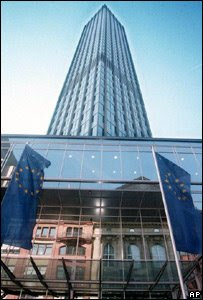
The very modest style of today's Euro Tower continues that tradition of deliberately low-key central banking

He assured me earnestly that such bags were very popular with foreign tourists.

But not, I suspect, with Germans, who have very long and anxious memories when it comes to the destruction of money.

For decades Germany's severe anti-inflationary policy was based on folk memory of the hyper inflation of the 1920s Weimar Republic, which disastrously undermined political and social stability.

Or the years at the end of the Third Reich, when the only valuable currency was cigarettes.

And that anxious memory fed into the deliberately low-key style of post-war German central banking.

The Bundesbank, when it ran the Deutschmark, was always housed in modest offices in a Frankfurt suburb.

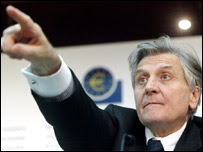
Jean-Claude Trichet, president of the ECBJean-Claude Trichet has been president of the ECB since 2003
Jean-Claude Trichet has been president of the ECB since 2003

And once when I went to see its former head, Helmut Schlesinger, who lived in a suburban house and often went to work on public transport, he told me he felt most accountable to the residents of his home village in southern Germany.

They would wag their fingers at him when he came to visit and ask: "Helmut, are you still looking after our money properly?"

So the very modest style of today's Euro Tower continues that tradition of deliberately low-key central banking and - whisper it elsewhere in Europe - symbolises what is still a very Germanic monetary policy.

And attempts are being made to pass the policy onto younger generations.

The bank's educational materials feature a trendy young couple, Anne and Alex, vanquishing an ugly inflation monster as they learn that price stability will enable them to buy more CDs.

Economic prospects

This approach worked well in the first 10 years of the European bank's existence as the economic climate has generally been favourable for all Europeans.

But as economic prospects worsen, there is an uneasy feeling that the supposed monetary solidarity that binds the single currency's 15-member states will be tested more severely than ever.

And if the bank itself wanted uncomfortable proof of this new era, it has found it while trying to move up in the property market.


Whatever the bank may say about its anti-inflationary zeal, prices for building materials are shooting up

As I left the visitor centre and its strange souvenirs, I noticed a video screen mounted on a wall with eye catching images of a new sky scraper.

This - the commentary proudly stated - would, in a few years, be the bank's new home.

Following its first successful years there were perhaps some among the bank's multi-national management who felt that a rather more striking HQ was appropriate.
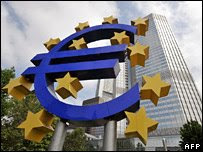
The bank is based in Frankfurt, the Eurozone's largest financial centre
Land was bought - the current Euro Tower is merely rented - and an architectural competition was held.

The Austrian winners, who had clearly been on a central banking course in baffling jargon, promised a multi-faceted building structure with the economical topology of a double slab high rise.

On hold

But what has been far from economical is the cost of trying to build it. When the bank tried to find a builder none came forward with a remotely acceptable price.

Whatever the bank may say about its anti-inflationary zeal, prices for building materials are shooting up.

Major building firms, global players these days, apparently believe that in the current economic climate they will make much more profit in say the Middle East than in Europe.

European Central Bank
The bank is based in Frankfurt, the Eurozone's largest financial centre

So embarrassment all round, as the bank's relocation plans have had to be put on hold.

The Italian and French governments - who like grand public sector projects and favour looser monetary policy to counteract economic downturn - might have advised the bank just to borrow the extra and go ahead anyway.

They like the idea that the European Central Bank is going to become a bit less strict in its policies as Europeans try to weather the current economic storm.

But I suspect that many Germans are quite pleased that whatever the economic weather the bank will remain for now in its modest, reassuring home, with contented rabbits down below, anti-inflationary hawks perched in the offices above.

And Europe's money managed as cautiously and consistently as possible.

Sunday, August 3, 2008

European currency falls to 15-day low against Japanese yen


During early deals on Friday, the European currency traded down against its major counterparts. The euro declined to a 15-day low versus the Japanese yen, 8-day low against the British pound and a 2-day low versus the US dollar.

Adding to euro's downward pressure, a report showed that German retail sales fell more than expected in June. German retail sales declined 3.9% year-on-year in real terms in June, much greater than the 0.8% slump expected by economists. The decline is in contrast to a 1% increase in May, revised up from the initially reported 0.7%. In nominal terms the increase was 1.2% in June compared to a 3.8% rise in the previous month.

Against the US dollar, the European currency traded down in early deals on Friday. At about 1:25 am ET, the euro-dollar pair touched a 2-day low of 1.5552, compared to 1.5605 hit late New York Thursday.

The European single currency declined to an 8-day low of 0.7850 against the British pound at about 1:15 am Eastern Time Friday. The euro-sterling pair closed Thursday's North American session at 0.7867.

Against the Swiss franc, the euro is currently trading at 1.6326, down from Thursday's close of 1.6339.

The European currency showed weakness against the Japanese yen in early deals on Thursday. At about 1:40 am Eastern Time, the euro-yen pair slipped to 167.33, down from yesterday's close of 168.42. This set a 15- day low for the pair.

Looking ahead, the manufacturing PMI reports from Germany, France, Italy and the Euro-zone for the month of July are expected in the upcoming hours.

The PMI for UK manufacturing industry is due at 4.30 am ET. Economists are expecting a reading of 45.5.

Across the Atlantic, the US change in nonfarm payrolls, unemployment rate, ISM manufacturing and construction spending reports are scheduled to be released.

Yearly euro inflation at record high of 4.1%


BRUSSELS, Belgium (AP) -- Yearly inflation in the 15 euro nations rose to a record high of 4.1 percent in July, the EU statistical agency Eurostat reported Thursday.
Inflation is becoming a headache across Europe as workers call for more money to meet surging fuel prices.

Inflation is becoming a headache across Europe as workers call for more money to meet surging fuel prices.

Prices have not climbed as fast since inflation records started in 1996 for the countries that eventually formed the euro.

Soaring fuel and food prices are Europe's biggest economic problem, eating into household spending -- one of the engines of economic growth -- as people steer away from major purchases and luxury goods.

Accelerating prices and signs that growth is stalling create a major dilemma for the European Central Bank, which acted last month to cool inflation by hiking borrowing costs for the first time in a year.

But the bank may have to hold back from more interest rate increases as the European economy stumbles and companies slash staff.

Eurostat reported that the jobless rate in the 15 countries that share the euro had risen to 7.3 percent in May and June from a year ago. It revised upward an earlier estimate of 7.2 percent for May as unemployment worsened from a record low it hit in December 2007.
Spain, hit hard by a housing slowdown, saw jobless lines increase sharply from June last year as the unemployment rate soared to 10.7 percent -- the highest among euro nations and in the 27-nation European Union. Nearly a quarter of Spanish young people do not have a job.

Ireland also saw a major increase in unemployment as a long boom comes to a sharp end. It reported unemployment of 5.7 percent last month.

Europe's largest economy, Germany, posted a jobless rate of 7.3 percent while France saw 7.5 percent.

Rising unemployment may serve as cold comfort to the ECB, which has pleaded with governments, employers and workers in euro nations to try and avoid wage hikes that could fuel an inflation spiral.

Slowing growth and the risk of further job losses may hold back wage demands despite workers' calls for their pay to keep pace with rocketing prices.

Ground staff at German airline Lufthansa AG have gone on strike seeking a 9.8 percent pay increase.

Inflation is fast becoming a political headache across Europe as workers call for more money and fishermen and truck drivers protest, sometimes violently, that surging fuel prices threaten their livelihoods.

Global oil prices have quadrupled in the last seven years, hitting Europeans hard because they also pay heavy taxes on fuel that can cost them some €80 ($126) to fill up a car's tank

Home Business & Finance News Top Stories Breaking City News Paper Tips Company Results and Outlooks Economic Indicators Funds Hot Shares IPO News Mer


NEW YORK, Aug 1 (Reuters) - The U.S. dollar climbed to five-week peaks against the euro and three-week highs against the British pound on Friday as better-than-expected economic data allayed worries about a much sharper slowdown.

The yen, on the other hand, gained broadly, benefiting from heightened stress in financial markets on news that General Motors (GM.N: Quote, Profile, Research) had hefty losses in the second quarter. That dragged U.S. stocks lower and triggered safe-haven bids for Treasuries.

"U.S. dollar sentiment has certainly changed for the better over the last couple of weeks," said Mark Frey, head foreign exchange trader at Custom House, a global payments dealer in Victoria, British Columbia.

"The U.S. economy has gone through some tough phases, but the jobs number was negative, but still better than expected. I think, more importantly, recent consumer confidence numbers and leading indicators, which are more forward-looking, have been more positive," he added.

Friday's data showed that U.S. employers eliminated 51,000 jobs in July, lower than market expectations for a payrolls decline of 75,000. A separate report said U.S. factory activity was unchanged in July, compared with the previous month, but above market forecasts

Economy at the time of COVID

The COVID-19 pandemic has spread with alarming speed, infecting millions and bringing economic activity to a near-standstill as countries im...